On Tuesday evening, I arrived back from my school Choir Tour to Slovenia and Northern Italy. The tour is an annual event, however this year's was sadly my last as I'm off to university in October! We enjoyed the same activities that we do every year such as singing in incredible buildings like St Mark's in Venice, eating the local food (endless amounts of pasta and pizza) and - of course - spending a considerable amount of time on a coach with the rest of the choir: 45 children and 7 adults (along with our very patient tour guide and coach driver). As anyone who has been on long journeys will know, time goes quicker when you have an activity to pass the time. For us, this meant rattling through everybody's collections of classical music and playing 'name that tune'. During this, I came across the music for a ballet that I have always loved, yet had somehow forgotten about as it isn't part of my own collection of music: The Nutcracker.
'The Nutcracker' is a two-act ballet composed by Tchaikovsky, and premiered in 1982. Although the ballet itself was not a roaring success when it first opened, the music definitely was, and is one of Tchaikovsky's most famous works to this day, including the music for 'Sleeping Beauty' which was the reason Tchaikovsky was commissioned to compose for 'The Nutcracker' in the first place. While listening to several different movements of the ballet on a friend's ipod, I remembered where I had first heard the music: Disney's 'Fantasia'.
For anyone who doesn't know the 1940s film, 'Fantasia' is a production by Disney that incorporates the greatest classical works from various periods and sets them to suitable animations. Unfortunately, the release of the movie put off previous Disney fans who believed the movie to be too 'high-brow' because of its inclusion of classical music. However, in my opinion, I believe it to be one of the most original animations out there, and demonstrates the power of creativity and interpretation. Here is Tchaikovsky's Nutcracker Suite, set to the images of what the Disney animators saw when they heard the music:
For today's post, I wanted to share a video of the close harmony group that I direct along with some of the other members. On Tuesday, I performed at my last ever school concert, and it was unexpectedly quite emotional to think that I wouldn't be doing the same thing next year. We decided to name our group: 'Vocalicity' as we were sick of calling ourselves the: 'Emanuel School Close Harmony Group' which, I'm sure you'll agree, doesn't have much of a ring to it. The reason I love this group so much is because it is created and directed by students. Despite there being varied ages from 15-18, we are all good friends, and being in a group together has in fact pulled us closer together. At so many school concerts these days, the end of the concerts are filled with various speeches thanking the horn teacher, or the piano teacher, or the singing teacher. However, for us, there is a much bigger sense of achievement because we have no teacher to help us, merely a huge interest in all kinds ofvocal music, and a willingness to sing to the best of our abilities. Having sung with them for the last two years, I feel a great sense of sadness knowing that next year I will no longer be part of it. However - being the oldest in the group - I also feel so proud of all the members of Vocalicity for sharing my passion for classical music, and for gaining true friendship out of it as well. As well as that, we've sung with internationally renowned group Voces8, as well as singing in prestigious venues around London such as Fortnum & Masons, and St John's, Smith Square. As I'm sure you would have guessed, working with a group of 10 teenagers isn't always easy as there is a lot of gossipping, chatting and texting going on, but it also has advantages such as creativity, energy and most of all: very varied opinions. For instance, some of us have a passion for the Renaissance era, some for Polyphony, and some for more modern styles and composers such as Gershwin and Leighton. But, that's what makes our rehearsals more interesting, and our performances more inventive. Therefore, I dedicate this post to the members of Vocalicity to say well done for all the hard work, thank you for the memories, and goodbye - for now!
Jonathan Dove is one of the great contemporary choral composers. However, he also composes for opera and film. My favourite of Dove's choral works is 'Seek Him That Maketh the Seven Stars'. The thing that is immediately striking about this piece is the opening, where we hear an organ ostinato, followed by the soft sound of a solo soprano singing the main theme. I find this piece to be incredibly effective for a number of reasons. First of all, despite fitting into the category of popular classical music, the piece has quite a deep complexity to it through Dove's use of themes, motifs and conceptual ideas. One of the most obvious is the repetition throughout of the phrase: 'seek him', giving an additional, emotional depth to the piece. As well as this, the piece - once heard - is very memorable, not because it's extremely loud or harsh on the ears, or because it uses a particularly unusual tonal centre, but because of its concept, paired with the subtlety of Dove's interpretation. My favourite touch is the slowest of the sections in which Dove writes in 7/8 (for the seven stars), as well as this, the music slows and fades to the words: 'into the morning'.
I chose this image because it is exactly what I picture as I hear the opening of the piece, especially the organ ostinato which creates a truly magical atmosphere. Not only do I hope to one day be able to write something as powerful as this, but also to be able to play the organ part!
'Seek Him That Maketh The Seven Stars' - performed by Tenebrae
Gustav Holst is undoubtedly most famous for his suite 'The Planets' written between 1914 and 1916. The work is made up of seven movements that represent each of the planets of the solar system (with the exception of Earth). As well as this, Holst chose to center the tone of each of the movements around the astrological character of each planet. The work is scored for an absolutely huge orchestra, containing the usual suspects such as strings, wind, percussion and brass with the few additions of less typical instruments such as the piccolo, celesta and tubular bells. Holst even included a small women's chorus in Venus.
Just as the movements are written to suit the astrological characteristics of each of the planets, Holst named them accordingly: Mars the Bringer of War, Venus the Bringer of Peace, Mercury the Winged Messenger, Jupiter the Bringer of Jollity, Saturn the Bringer of Old Age, Uranus the Magician and Neptune the Mystic. Although Pluto was discovered four years before Holst died, he chose not to write an additional movement as he resented the fact that the suite's popularity took away attention from the rest of his works. Despite the fact the suite portrays Holst's musical style throughout, some are extremely varied, and show Holst to be a true chameleon of composition.
My favourite movement is Jupiter the Bringer of Jollity. Out of all seven movements, this one definitely has the most captive opening with virtuosic strings overlapped with the nobility of the brass. This wonderful flurry of sound is then joined by the rest of the orchestra, and the moments of suspense created by held 'stinger' chords in the strings are accompanied by the brilliance of horn and trumpet solo lines which develop into the first theme of the movement. Some of my favourite moments are the contrasted sections between the sound of the brass against the sweet and innocent sound of percussion and wind when they take over the melody. Out of all the intricate details in Jupiter, the movement is most famous for its theme halfway through, that was eventually adapted into the hymn 'I Vow to Thee My Country', and - as this is one of the most well-known hymns in the country, Jupiter has from then on been associated with patriotism. To honour this, it was chosen to be played by the London Philharmonic Orchestra as the finale for the Queen's Diamond Jubilee Boat Pageant a couple of weeks ago. Unfortunately because of the awful weather, the event was called off early, and it was never played. Outraged by this, I felt it was my duty to post it for all to here. This recording however, is performed by the Chicago Symphony Orchestra.
About three and half years ago, my family was unfortunate enough to lose somebody to cancer. After reading the blog post that my Mother had written to commemorate the anniversary of his passing, it made me want to make my own musical tribute. Even though this post marks no anniversary or special occasion, it makes the point that people who are missing are missed at any given time of any year, no matter how long they've been gone.
Music is obviously incredibly emotional. We can see this in elements of classical music such as Beethoven's passionate style and the atmospheric creations in film music. Because of this, we all have a very powerful relationship with music. We all have something to listen to when we're down (Joni Mitchell perhaps?) and something when we're up (for me, Bach). Music is also a very powerful memory trigger that can bring tears to our eyes and smiles to our faces, and: 'A Nightingale Sang in Berkeley Square' is what I listen to, to remember my Stepfather.
There have been endless performances and adaptations of the song, but Frank Sinatra's is my favorite. In my opinion, it is simply not possible to dislike this performance. This song holds such musical charm in the swaying of strings, the wooing of the wind and of course, the legendary voice of Frank Sinatra.
In the text, the singer's recollection is of a wonderful memory, and, by listening to this song, it reminds me of my own wonderful memories. This is definitely the true beauty of music.
I want to start this post by admitting: I love John Rutter. In the world of classical music, musicians are often very harsh about Rutter's musical style because they find it to be too cheesy, too simple or even boring. This post is to argue the case that John Rutter is, in fact, a wonderful composer.
John Rutter Born 1945
As a composer, conductor, arranger, editor and record producer, Rutter's musical influence comes mainly from traditional French and English choral music, as well as some influence from American songs. Rutter is best known for his choral anthems and hymns with a typical piano/organ accompaniment, often rearranged for full orchestra. The anthems he is most known for are probably: 'For the Beauty of the Earth', 'All Things Bright and Beautiful' and 'The Lord Bless You and Keep You' (which happens to be my favorite). Despite the fact Rutter often composes religious music, he has said that he is not particularly religious himself, but very spiritual. This definitely comes across in the melodies and harmonic textures of his music.
Whenever I've had a conversation with other musicians about John Rutter, I am always told that I'm stupid for liking his music. I even expressed my like for his music to a prospective university professor and got the reply: ''well, I suppose someone has to like him''. In a way I agree with some that he doesn't have particularly complex or challenging music, and the harmonies are often very cheesy and predictable. But, I stand by the fact that his music serves a spiritual purpose that brings joy to many. Personally, I find it uplifting and satisfying to listen to (although I will admit that it's not something I'm always in the mood for).
My favorite of his anthems is 'The Lord Bless You and Keep You'. This is by far the most emotional and touching of all his choral anthems. My school choir have been singing it for about fifteen years, and I still seem to be the only person who doesn't groan when my choirmaster takes it out of its folder. Here is the track for you to listen to and decide for yourself:
Today, I want to talk about one of my favorite musical texts - as well as comparing two very different versions of it. There are several adaptations of the text from various composers, however I first came across 'When David Heard' by Thomas Tomkins. Even without being set to music, the text is intense and emotional as it describes David's grief at the sight of his dead son; Absalom.
The text reads:
When David heard that Absalom was slain, he went up to his chamber over the gate,
And wept, and thus he said: O my son Absalom, would God had I died for thee!
Thomas Tomkins 1572 - 1656
Tomkins was a Welsh composer from the late tudor period, and belonged to several elitist groups of composers known for their talents particularly in a capella composition. Out of the two, Tomkins' setting of the text may seem the simpler. However, if you listen more closely, the most interesting aspect of this work (and of the musical style at the time) is the constant change between major and minor that paints a picture of grief very well. The most beautiful moments are perhaps in the quieter sections in which the high tenor and alto entries carry a single line, that develops into all five voice parts (SAATB) singing the phrases back and forth until coming to a homophonic texture at the end of the phrases. An example of these tender solo moments is at 1.27 where the tenor and alto blend together unnoticeably until splitting into separate parts.
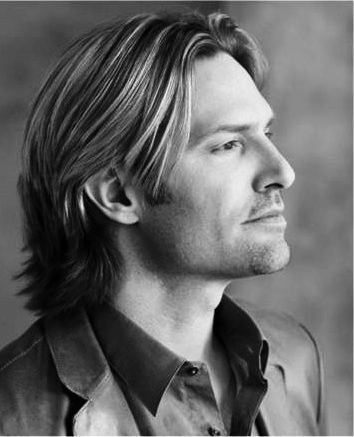
Eric Whitacre Born 1970
In complete contrast to the typical (yet beautiful) sounds of Tomkins' ancient polyphony, Eric Whitacre's setting of the music is slightly different - obviously because of the additional modern influences that he has as a contemporary composer. For me, this setting is the more powerful of the two as it has contrasted sections, dissonant harmonies and an almost minimalistic feel as it stays on the same phrase several times - (I'm sure as an intention by Whitacre to emphasise the emotions portrayed in the text). As well as this, the setting is for more voices: SSAATTBB which creates a bigger sound and a more atmoshperic feel in the piece, and Whitacre uses silence as well as music to create dramatic effect. However, one similarity is the composer's use of solo phrases, particularly the phrase: 'Absalom my son' in the second section.
However, this is only my personal opinion, and I do of course love both pieces. Here are the two for you to listen to and make your own judgement. Although be warned, Whitacre's setting is over fifteen minutes! (In my opinion, it's still worth it).